Maths Methods · Year 12 · Unit 3
The chain rule in QCE Maths Methods: a step-by-step guide
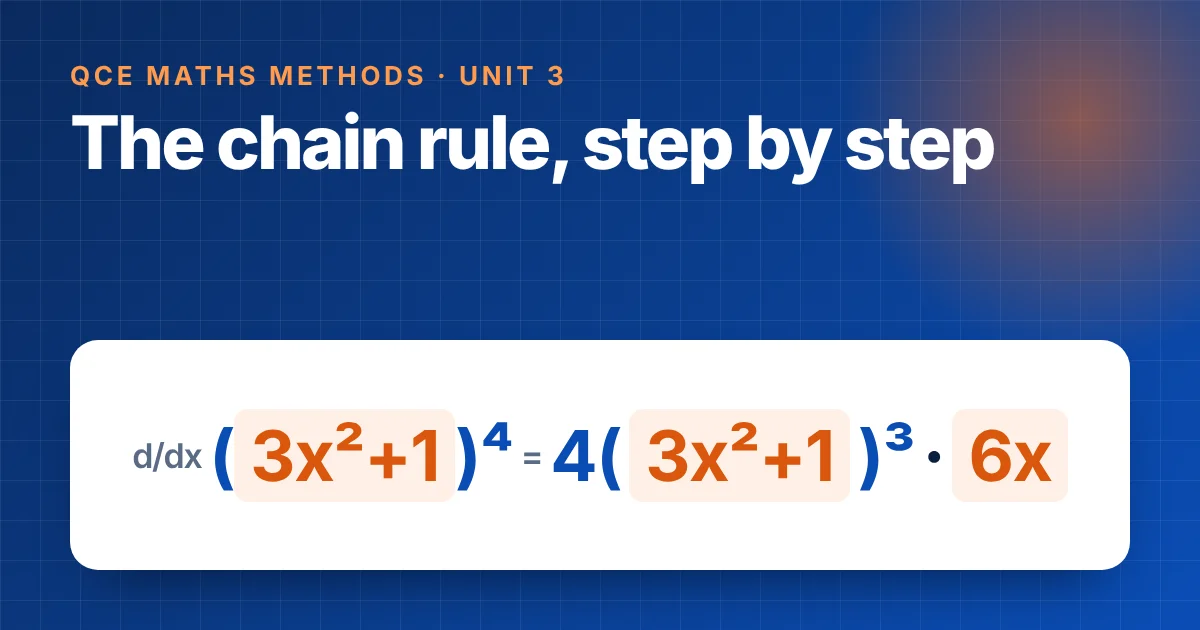
The chain rule is one of the first places where Year 12 Maths Methods students lose marks. The idea is simple, but it’s easy to forget a step under exam pressure. This guide shows a reliable method you can use every time, with worked examples.
When do you need the chain rule?
You need the chain rule whenever you differentiate a function inside another function. Look for brackets raised to a power, or a function like sin, cos, ex or ln with something more complicated than just x inside it.
- (3x² + 1)4: a power of a bracket
- sin(5x): sine of something other than x
- e2x² − 3x: e to a power that isn’t just x
- ln(x² + 4): ln of an expression
- √(1 − x²): a square root of an expression
In Queensland, the chain rule is taught in Unit 3 of Mathematical Methods alongside the product and quotient rules.
The 3-step method
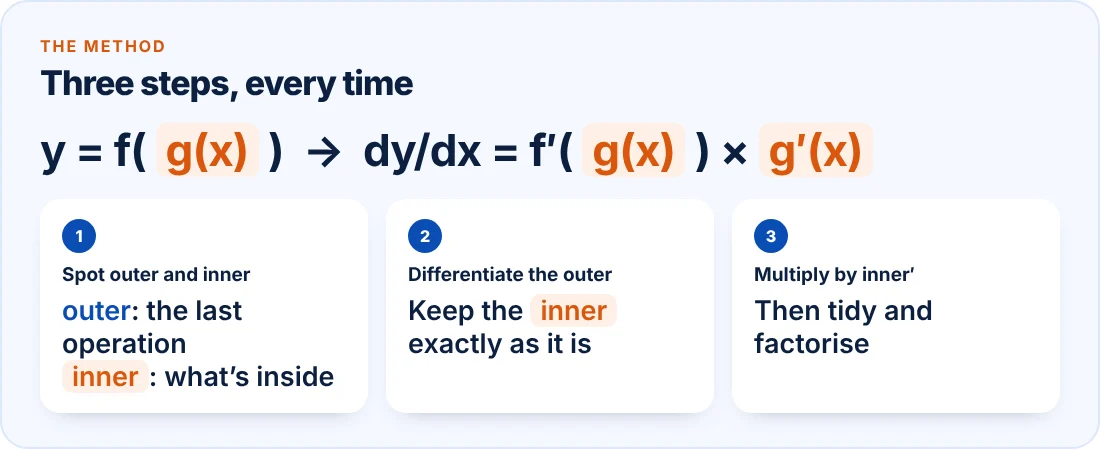
If y = f(g(x)), then dy/dx = f′(g(x)) × g′(x). In words: differentiate the outside, keep the inside the same, then multiply by the derivative of the inside.
- Identify the inner and outer functionsAsk: what is the last thing I would do if I put a number in? That’s the outer function. What’s inside it is the inner function.
- Differentiate the outer functionLeave the inner function exactly as it is inside.
- Multiply by the derivative of the inner functionThen tidy and factorise if you can.
Worked examples
Example 1: a power of a bracket
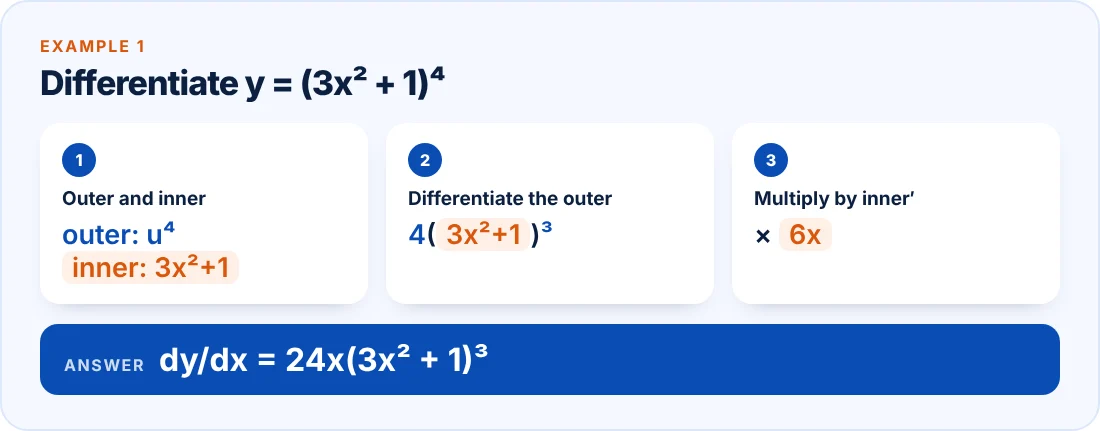
Differentiate y = (3x² + 1)4.
Outer: ( )4. Inner: 3x² + 1.
dy/dx = 4(3x² + 1)3 × 6x = 24x(3x² + 1)3
Example 2: a trig function
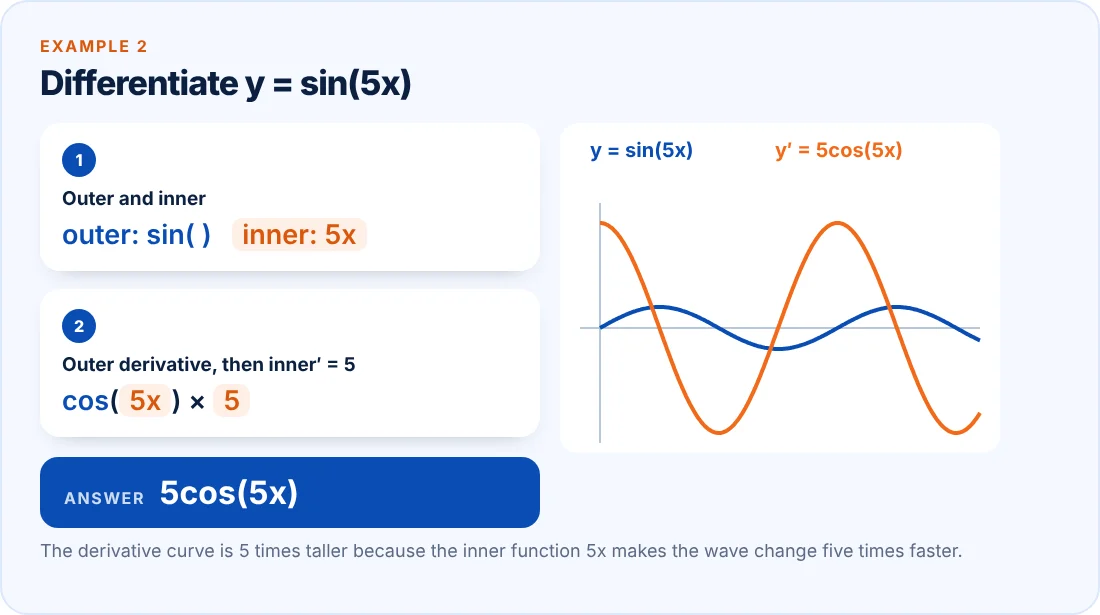
Differentiate y = sin(5x).
Outer: sin( ). Inner: 5x, with derivative 5.
dy/dx = cos(5x) × 5 = 5cos(5x)
Example 3: an exponential
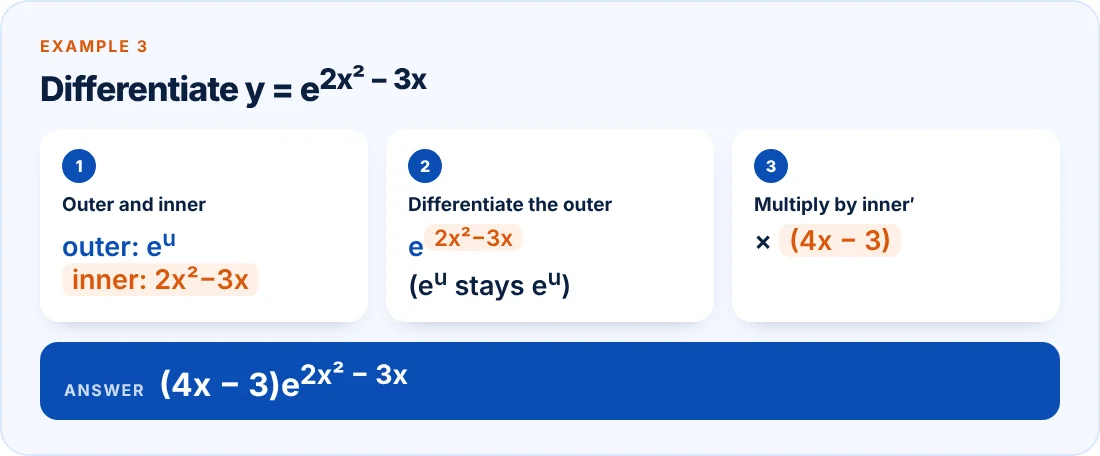
Differentiate y = e2x² − 3x.
Outer: e( ), which stays as e( ). Inner: 2x² − 3x, with derivative 4x − 3.
dy/dx = (4x − 3)e2x² − 3x
Example 4: a logarithm
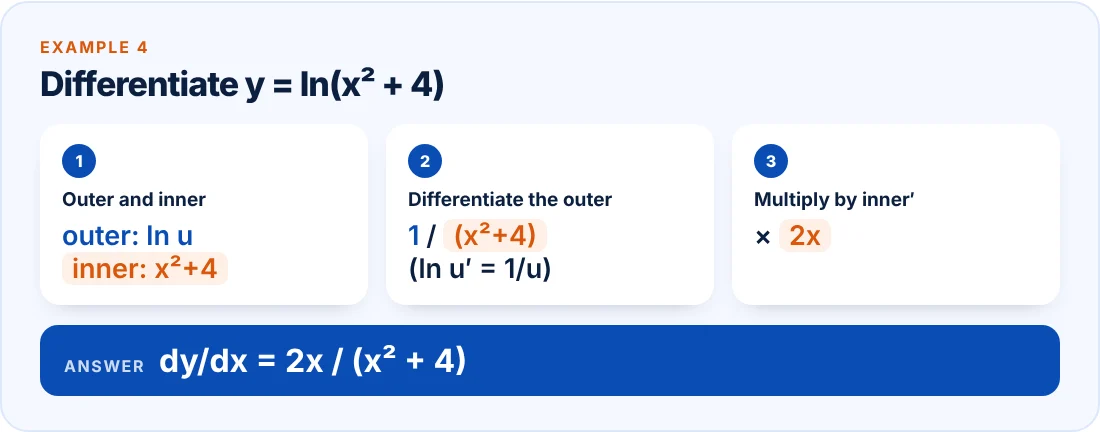
Differentiate y = ln(x² + 4).
The derivative of ln(u) is 1/u, so the outer derivative is 1/(x² + 4). The inner derivative is 2x.
dy/dx = 2x / (x² + 4)
Example 5: a square root
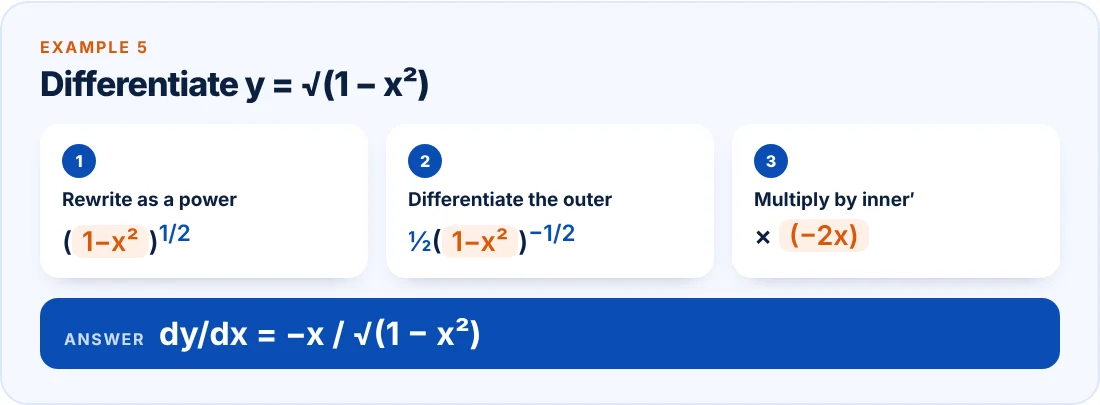
Differentiate y = √(1 − x²). Rewrite it first as (1 − x²)1/2.
dy/dx = ½(1 − x²)−1/2 × (−2x) = −x / √(1 − x²)
Chain rule with the product rule
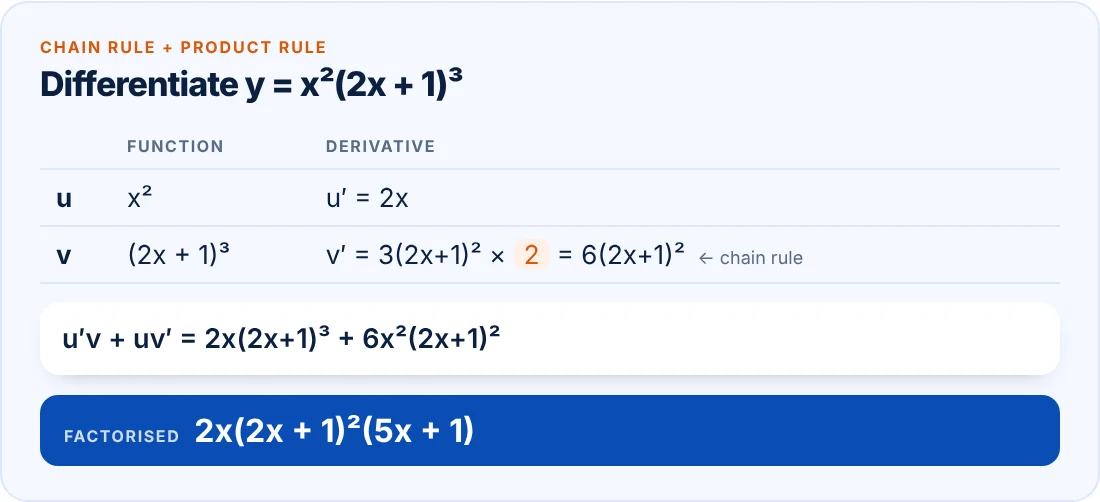
Exam questions often combine rules. Differentiate y = x²(2x + 1)3.
This is a product of u = x² and v = (2x + 1)3. The product rule gives dy/dx = u′v + uv′, and finding v′ needs the chain rule: v′ = 3(2x + 1)2 × 2 = 6(2x + 1)2.
dy/dx = 2x(2x + 1)3 + 6x²(2x + 1)2
Factorise the common factor 2x(2x + 1)2:
dy/dx = 2x(2x + 1)2[(2x + 1) + 3x] = 2x(2x + 1)2(5x + 1)
Factorised answers make the next step, such as finding stationary points, much easier.
Common mistakes
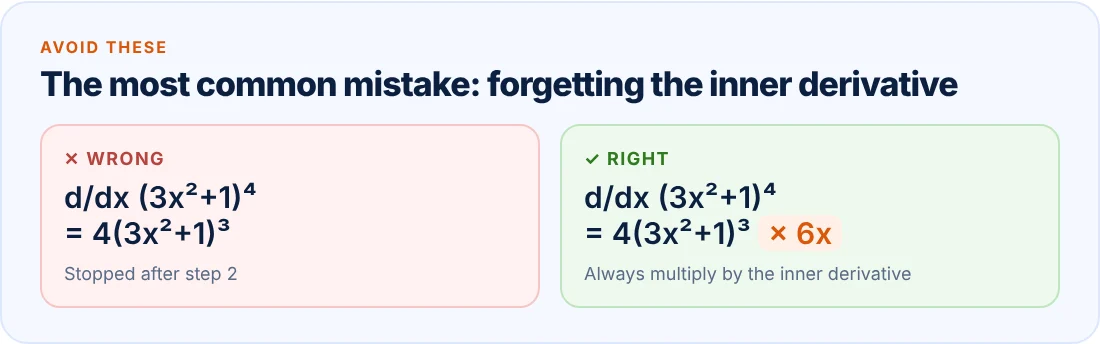
- Forgetting the inner derivative. Writing 4(3x² + 1)3 and stopping is the most common error. Always ask, “what did I multiply by?”
- Changing the inside. In step 2 the inner function stays exactly the same. (3x² + 1)3 does not become (6x)3.
- Missing hidden chain rule questions. sin²(x) means (sin x)2, so its derivative is 2 sin x cos x. It’s a power of a function.
- Sign errors with the inner derivative. In √(1 − x²), the inner derivative is −2x, not 2x.
- Not simplifying. Factorising helps you spot errors and is often needed for the next part of the question.
Practice questions
Try these, then check your answers below.
- Differentiate (5x − 2)6
- Differentiate cos(3x²)
- Differentiate e4x+1
- Differentiate ln(2x − 5)
- Differentiate x(x + 3)4
Show answers
- 30(5x − 2)5
- −6x sin(3x²)
- 4e4x+1
- 2/(2x − 5)
- (x + 3)3(5x + 3)
Stuck on a topic in Methods?
A one-on-one tutor can find exactly where the idea breaks down and teach it a different way. See Maths Methods tutoring, or request a call back and we’ll match a maths teacher to your child.
Request a call backChain rule: common questions
What is the chain rule in simple terms?
Is the chain rule in QCE Maths Methods?
How do I know when to use the chain rule?
What is the difference between the chain rule and the product rule?
Keep reading: Starting Year 11 in Queensland · Year 12 study plan · Specialist Maths tutoring